

Pitti Palace
In the Prologue of Inferno Dan Brown writes:
I pass behind the palazzo with its crenellated tower and one-handed clock… snaking through the early-morning vendors in Piazza di San Firenze with their hoarse voices smelling of lampredotto and roasted olives.
We cannot help but say something about the king of Florentine cuisine, tasted every day in the streets of the city by Florentines and lately also by many tourists: the lampredotto!
Pellegrino Artusi, considered the father of modern Italian cuisine and naturalized citizen of Florence, wrote these words at the beginning of his famous book of recipes:
It is true that man does not live by bread alone; he must eat something with it. And the art of making this something as economical, savory and healthy as possible is, I insist, a true art
(Pellegrino Artusi, The Science of Cooking and the Art of Eating Well)
It seems that Artusi has learned this maxim from Florentines, as it particularly applies to the legendary lampredotto.
In Florence, the lampredotto is an institution, loved as much as Dante and Brunelleschi’s dome.
The tradition of eating tripe and entrails in Florence is very old and probably arises from the need to combine the simple bread with something inexpensive but nourishing.
In fact, Medieval chronicles and novels refer to tripe, entrails, offal, and giblets as typical Florentine food.
We do not know where Dante and famous Florentines of the past consumed this delicacy, but today you can find lampredotto sandwiches in many squares and streets of the city.
What is lampredotto?
To fully understand the lampredotto, a quick explanation is in order.
Trippa (tripe), made from the cow’s pre-stomachs, is soft, white, and mostly flavourless. Enjoyed in many regions of Italy, it is cooked in a variety of ways.
Lampredotto, a uniquely local Florentine speciality, is made from the cow’s fourth stomach, called the abomasum.
The abomasum consists of two distinct meats: a lean, darkly coloured, more flavourful meat; and a lightly coloured, fatty, and lightly flavoured part.
The name lampredotto comes, rather curiously, from the name of an eel, the lampreda, which once abounded in the Arno. When open, the mouth of the lampreda features a variegated, suction-pad aspect very similar to the coloured layers of lampredotto.
Lampredotto and trippa have forever been the choice food of laborers and the working classes.
Many of the oldest surviving kiosks in Florence are in the market areas, where traditional handcrafted goods manufacturing workshops were once situated, as for example, in the San Frediano area. Back in the 1980s, their numbers had dwindled to five or six, and they often obtained their raw materials free of charge simply because they were the bits that serious butchers discarded.
Now there are approximately 30 kiosks around the city, including one at the shopping mall I Gigli just outside Florence. Typical clients are both blue- and white-collar workers, including women, and the kiosks themselves are often expensive, four-wheel mobile devices with gleaming stainless steel cooking facilities.

Florence consumes approximately 250,000 kg of trippa (246 imperial tons) and 80,000 kg (79 imperial tons) of lampredotto each year.
How to cook Lampredotto
Tuscan cooks rinse lampredotto well and boil it with tomatoes, onions, parsley, and celery for two to three hours, serving it with a traditional parsley-based sauce, salsa verde.
It can also be prepared in zimino and tossed in a pan together with chard or spinach, with pasta (pennette) or with Tuscan beans. The expression “in zimino” is typically Tuscan.
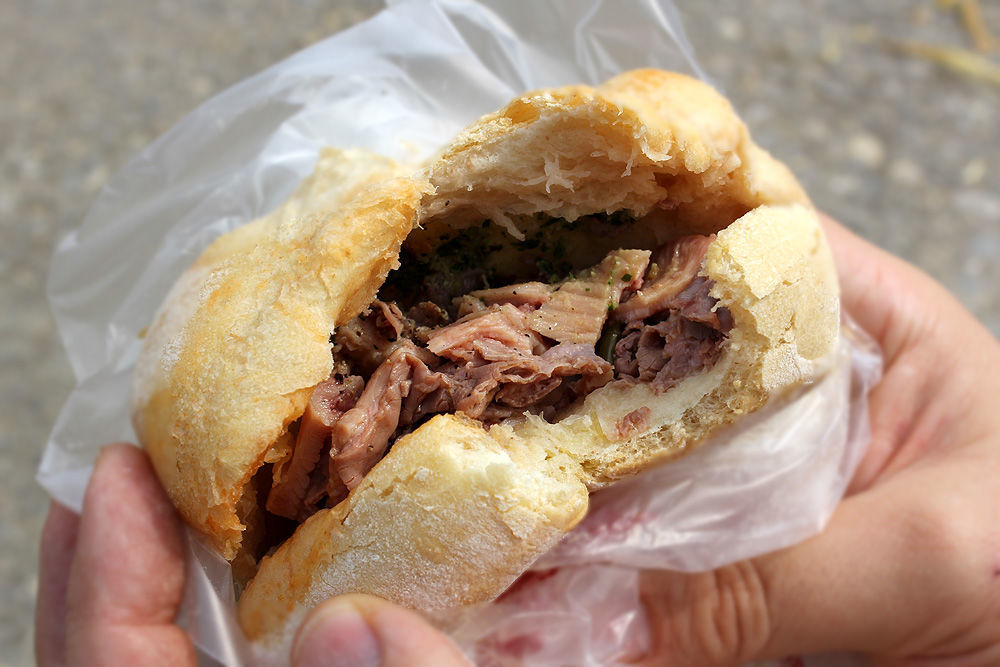
The most traditional way of all, however, is serving it in a Tuscan saltless bread roll with salt, pepper, chilli oil, or salsa verde (parsley, capers, and garlic), with the top slice of the roll dunked in the lampredotto stock.
Whatever version you choose, lampredotto and trippa are meant to be enjoyed with a gottino di vino, or small shot of red wine, preferably a Chianti.
The lampredotto sandwich is real Italian street food! The Florentines eat it at any time: breakfast, lunch with a glass of wine, or dinner with friends.
Peddlers of lampredotto are called trippai, and their craft is a proper art.
Patrons eat standing up but not in a hurry. They taste the sandwich in company, talking about football or current events.
Everyone in Florence except for vegetarians loves the lampredotto sandwich: lawyers, bricklayers, students, and professional people.
The two most famous trippai in Florence are located in Via Pellicceria near the Fontana del Porcellino (Fountain of the Boar) so dear to the Florentines, and in Piazza de’ Cimatori, near the House of Dante.
This last location is also very close to the Piazza di San Firenze quoted by Dan Brown.
Eating the gelatinous bits takes some courage, but it takes just one bite to get hooked. They say that Michelangelo loved it: you can’t get a much better celebrity endorsement than that!
It seems fair to not separate these two great symbols of Florence: Dante and the lampredotto.
Lampredotto was born as a dish for the very poor and humble, but over the centuries it has become the pride and favorite dish of the Florentines.
Similarly, Dante wrote The Divine Comedy in a vernacular and common language, but it later became the noble Italian language.
In Florence, as we say, “we are born frogs and die princes”!
Buon appetito…
This post was originally published on June 15, 2013, and has been updated and enriched on October 16, 2018
Picture by Lampredotto panino by Rowena CC BY-NC-ND 2.0; Florentine street food by Eric Parker CC BY-NC 2.0

Related posts


