

The Battle of Marciano
In Dan Brown’s Inferno, Robert Langdon is terrified when he recognizes Malebolge in his recurring visions, and we know why.
Dante describes Hell in his Divine Comedy as an inverted funnel divided into nine circles, exactly as illustrated in Botticelli’s Map of Hell.
In each circle, a specific type of sinner is punished according to the law of contrapasso or retaliation, which means that each malefactor is punished with a suffering that has something in common with his sin—something similar or in contrast.
For instance, fortune-tellers have to walk with their heads on backward, unable to see what is ahead, because this is what they have tried to do in life in predicting the future.
Malebolge is the name given by Dante to the eighth Circle of Hell, the only circle that has a proper name. Dante set several cantos of his Inferno in the Malebolge, precisely chapters from Canto 18 to Canto 30.
Malebolge means evil ditches, and this Circle is dedicated to the sins of fraud, and each ditch is for a specific kind of fraud.
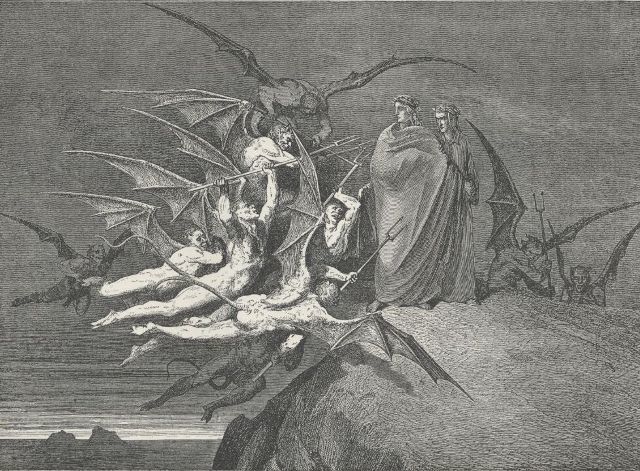
From this point on are punished the sins committed with malizia, which means with an intention to harm people with violence or deception. The devils in this area are very ferocious and frightening.
Malebolge is the kingdom of darkness, and for Dante it is not easy to enter this circle: the poet is terrified by the legions of demons that appear in front of him and try to block the entrance.
The words of the poet Virgil, his guide, will not be enough: they will need divine intervention to overcome the devils.
As mentioned above, the eighth circle of Hell is divided into ten bolge, each dedicated to a different kind of guilt.
Bolgia means ditch, from the shape of the infernal pit cave that contains the damned.
Here you find the division of the damned in Malebolge and their punishment according to the rule of retaliation:
Ditch 1: Panderers and Seducers: they are whipped by devils.
Ditch 2: Sinners guilty of excessive flattery: they are immersed in the dung.
Ditch 3: Simonists: they are stuck in a hole upside down, with the soles of their feet burning with flames.
Ditch 4: Soothsayers: they walk with their heads turned backward.
Ditch 5: Grafters: they are immersed in boiling pitch.
Ditch 6: Hypocrites: they walk wearing heavy leaden robes, painted with gold
Ditch 7: Thieves: they have their hands tied behind their backs by snakes and suffer horrible metamorphosis.
Ditch 8: Deceivers who gave false or corrupted advice to others for personal benefit: they roam the pit, wrapped in a flame.
Ditch 9: Sinners who in life promoted scandals, schism, and discord: they are mutilated by a devil with a sword.
Ditch 10: Falsifiers: forgers of metals are affected by scabies, those of people snapping together, forgers of coins are tormented by thirst, and those of words are suffering from high fever.
In this Canto of The Divine Comedy is an episode that is fun, if we think of the fiery and irascible character of Dante Alighieri and the family:
Dante travels through a swamp to reach the eighth circle, and the damned swim in the putrid mud. Among these sinners, the poet recognizes the Florentine Filippo Argenti, condemned to Hell for the sin of anger.
Dante unceremoniously places in Hell a fellow famous for his hot temper and also mentioned by Boccaccio in his novels. He was guilty of having once slapped Dante in the streets of Florence and for being part of the Adimari family, the Florentine family responsible with others for exiling Dante from his city.
Once again two famous Florentines reveal quite a fiery temper!
» If you are interested in reading a good, easy to understand rendition of The Divine Comedy which includes several drawings selected from Botticelli’s series of illustrations, we recommend the Mandelbaum edition.
Picture by Wikimedia

Related posts


i really like to understand correctly all of the sins in bahasa Indonesia 🙂