

The Battle of Marciano
Have you ever worn the mask? Read and then respond.
It was the same early Greek pictogram that adorned most playbills around the world — a 2,500-year-old symbol that had become synonymous with dramatic theater.
Le maschere. (Dan Brown, Inferno)

Just as theater for the Greeks is not a mere representation but life itself, the mask does not represent the god or the character, but “is” that god or character. It captures their essence.
Originally, the Greek use of masks related to human spirituality and sentiment. As such, masks were often identified with the main deity. Even on stage the ancient magical powers of masks are alive.
With the onkos, which was an extremely elevated hairstyle, the mask helped to magnify the actor and, together, eliminate his personality, the character stylization wasnfixed in a grimace, with tears in tragedy and rice in the play.
Another important function of the mask was to act as a “sounding board” (through the use of the open mouth of the mask as a voice “amplifier”).
The Tragedy Mask
Its origin is attributed to an actor named Thespis from the second half of the sixth century BC, who began to paint his face with white lead, perhaps from having been inspired by the make-up made from musk, soot or ink used by participants in the Dionysian rites.
Thespis is also attributed with the introduction of the mask canvas, which was initially unpainted. In the following centuries, the canvas, reinforced with stucco, remained the most widely used material.
Masks later began to be painted – black for the male, while the masks for the females were left white. Aeschylus was the first person to paint the masks with different colors. Given the above, it is only at the beginning of the classical period that we can speak of a development in the expressive mask of tragedy.
Later, facial expressions were given an increasing amount of importance, until they became exaggerated in the Roman era.
Many tragic masks have the “eyebrows of Laocoon”, an unmistakable expression of tragic pain.
Even the eyes are oblique, following the pathetic attitude of the eyebrows. The corners of the mouth are turned down, and the deep lines from the nose to the mouth clearly express pain and despair.
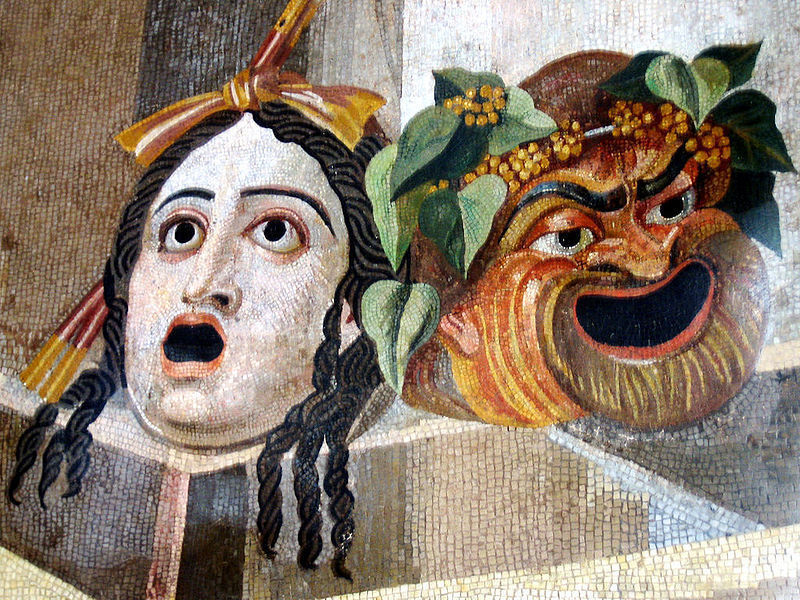
Especially in Roman times, all the passions are depicted in strongly deformed masks. At the same time, however, the details of the mask began to become larger and coarser: combing rises excessively; the huge openings of the eyes and mouth occupy the entire face excluding any difference of expression.
These exaggerations, which also succumbed to the comic mask of the late Roman period, led to a unique combination of the two types of masks that were once opposed: tragedic and comedic.
In the Roman period, an increasing amount of reproductions of masks in marble, terracotta or bronze were made, next to the large number of frescoes and mosaics: the tragic mask became an import aspect of beloved Roman decorative art.
The Comedy Mask
Our knowledge of masks of comedy stem from ancient clay figurines of actors dating to around 400 BC. These figurines wear masks that do not hide their religious origins: the eyes are large and bulging under eyebrows frowning or raised menacingly; under the snub nose, a small mouth, widened to a grin, is slightly open.
The comedic mask expressed rather malice and villainy. In this way heroes were caricaturized: Hercules, first of all, followed by even the gods, and finally ordinary people and famous contemporaries, for which the mask was used to make real portraits.

With the passage of time, the masks have changed to represent realistic and professional characters. However, they are still partly grotesque and represent a somewhat general human face; masks from which the new comedy will form fixed types.
The tragic parodies gradually set aside the old mythological farces.
Pictures by Wikimedia

Related posts


It is hard to believe that something as simple as these two masks could have endured into the modern age with their original intent still being known and adhered to
Never Look down, things change