

Sandro Botticelli
Paul Gustave Doré was a prolific French engraver, artist, illustrator, sculptor, and primarily, wood and steel carver.
Robert Langdon, the main character in Dan Brown’s Inferno, being a renown Dante scholar, exhibited a Gustave Doré lithograph depicting a dark entrance to a tunnel carved into the face of an austere cliff during a conference hosted by one of the world’s oldest Dante societies—the Società Dante Alighieri Vienna. Moreover, during one of his adventures, Langdon refers to Doré’s work Dandolo Preaching the Crusade.
Doré Biography
Paul Gustave Doré was the second of three children born to Pierre Louis Christophe Doré, an engineer, and his wife Alexandrine Marie Anne Pluchart. Doré was born in Strasbourg on January 6, 1832, and died in Paris on January 23, 1883.
Doré is considered one of the most successful book illustrators of the late nineteenth century, whose exuberant and bizarre fantasy created vast dreamlike scenes widely emulated by Romantic academicians.
His biographer, David Kerr, has pointed out that, as “a child prodigy, Doré received little formal artistic training, but his talents as a draughtsman were already apparent during his school years.”
At the age of five he was a troublemaker of prodigious talent, playing pranks that were mature beyond his years. Seven years later, he began carving in cement.
As a young man in 1847, he began working as a literary illustrator in Paris. Here he produced weekly lithographic caricatures for the Journal pour Rire and several albums of lithographs, winning commissions to depict scenes from books by Rabelais, Balzac, Milton, Edgar Allen Poe, and Dante.
Doré continued to illustrate books until his death in Paris on January 23, 1883, following a brief illness.
According to Kerr, “the speed with which he drew was legendary and his output was as noteworthy for its quantity as for its quality.”
The birth of the Doré Gallery in London
In 1863 Doré was asked to illustrate the works of Lord Byron. This commission was followed by other work for British publishers including a new illustrated Dore’s English Bible (1865), which was a huge success.
In 1867 Doré had a major exhibition of his work in London, which led to the foundation of the Doré Gallery in Bond Street, London. In 1869, Blanchard Jerrold, the son of the dramatist Douglas William Jerrold, suggested that they work together to produce a comprehensive portrait of London.
The Doré Gallery was originally opened to exhibit and publicize the work of Doré, but in the early twentieth century, the gallery also hosted rotating exhibitions of international artists.
The illustrations’ series of the “chefs-d’oeuvre de la littérature”
Already in 1855 Doré had planned to devote a series of illustrations to classical world literature, beginning with The Divine Comedy of Dante Alighieri. He realized the project between 1861 and 1868.
The Dante illustrations were the first in a series that he referred to as the “chefs-d’oeuvre de la littérature.” In addition to Dante, Doré’s list of illustrated great works included Homer, Ossian, Byron, Goethe, Racine, and Corneille.
Doré’s choice of Dante’s Inferno as the first of his proposed series of illustrated masterpieces of literature reflects the extent to which Dante had attained popular appeal in France by the 1860s.
Dante’s popularity within mainstream French culture by the 1850s was great. While France’s initial interest in Dante was confined to the episodes of Inferno, Canto 5, and Inferno, Canto 33, the nineteenth century witnessed an expansion of interest in Dante’s work, which resulted in numerous translations of The Divine Comedy into French critical studies, newspapers, and specialized journals, and over 200 works of painting and sculpture between 1800 and 1930.
Finding it difficult to secure a publisher willing to take on the expense of producing the expensive folio edition, Doré decided to self-finance the first book Inferno. The production was an immediate artistic and commercial success.
Buoyed by the popularity of Doré’s edition of the Inferno, the French publisher Hachette published Purgatorio and Paradiso in 1868 as a single volume. Subsequently, Doré’s Dante illustrations appeared in roughly 200 editions, with translations from the poet’s original Italian available in multiple languages.
The illustrations of The Divine Comedy by Dante Alighieri
For his work on Dante’s Inferno, Doré was decorated with the Cross of the Legion of Honor.
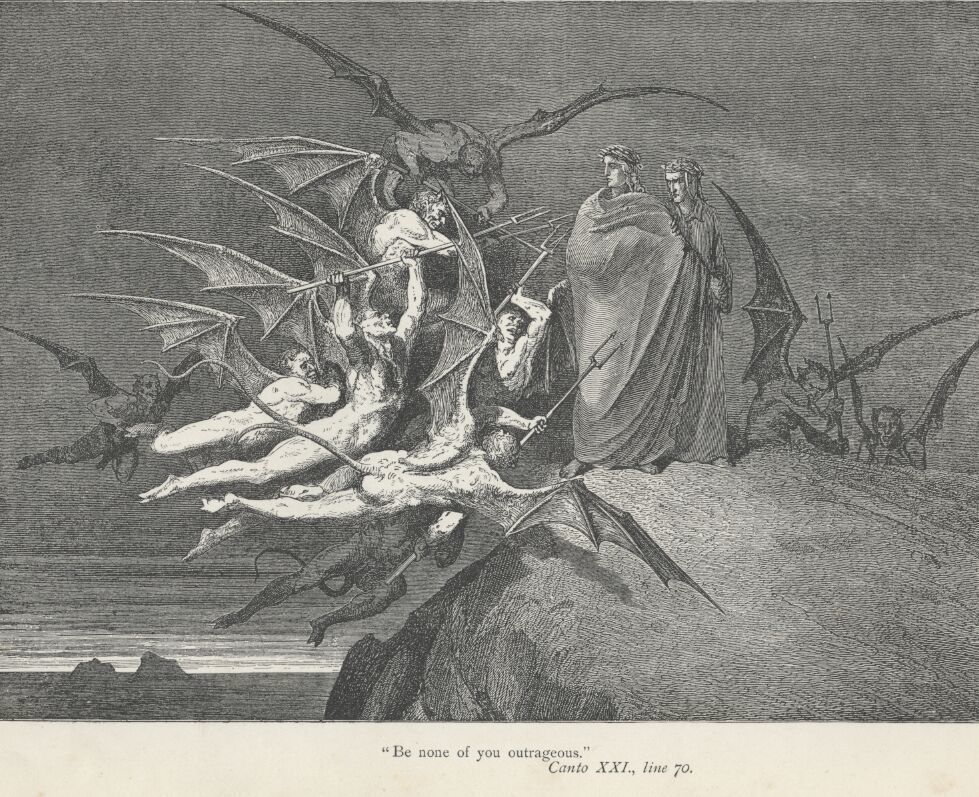
The Commedia illustrations are characterized by an eclectic mix of Michelangelesque nudes, northern traditions of sublime landscape, and elements of popular culture. Doré’s Dante illustrations were considered among his crowning achievements—a perfect match for the artist’s skill and the poet’s vivid visual imagination.
As one critic wrote in 1861 upon publication of the illustrated Inferno, “we are inclined to believe that the conception and the interpretation come from the same source, that Dante and Gustave Doré are communicating by occult and solemn conversations the secret of this Hell plowed by their souls, traveled, explored by them in every sense.”
Paul Gustave Doré’s illustrations and Dante’s Divine Comedy have become so intimately connected that even today, nearly 150 years after their initial publication, the artist’s rendering of the poet’s text still determines our vision of The Commedia.
Picture by wikipaintings.org

Related posts


