Florence InfernoFlorence Inferno
Florence Inferno
Symbols and places mentioned in Dan Brown’s novel Inferno, and much more about Florence
FacebookTwitterGoogle+PinterestYouTubeTumblrTripAdvisor
  • Home
  • The Inferno Guide & Blog
    • Book & Movie
    • Places
    • Symbols
    • Personalities
    • Works of Art
    • Dante & his Work
    • Mystery Stuff
    • Miscellany
  • Walking Tours
  • Interesting Books
  • Audio eBook
  • Map
  • About & Contacts
 
  • Home
  • The Inferno Guide & Blog
    • Book & Movie
    • Places
    • Symbols
    • Personalities
    • Works of Art
    • Dante & his Work
    • Mystery Stuff
    • Miscellany
  • Walking Tours
  • Interesting Books
  • Audio eBook
  • Map
  • About & Contacts

The Cylinder Seal

June 18, 2013Inferno's Symbols

Cylinder seals are artifacts that appeared around 3400–2900 BC in ancient Mesopotamia.

A cylinder seal is a small stone cylinder engraved in intaglio on its surface in order to leave impressions when rolled on wet clay.

Cylinder seals were used to mark personal property and to make documents legally binding: in fact, their use was reserved for the authorities.

These artifacts were used as seals for large or small containers, such as Medieval sealing wax.

Cylinder seals also had a religious function, having the purpose to invoke divine protection.

The earliest examples used geometric, magical, or animal patterns, while later seals incorporated the owner’s name.

Sometimes, the elements were arranged in symmetrical or decorative patterns, but an action was often represented.
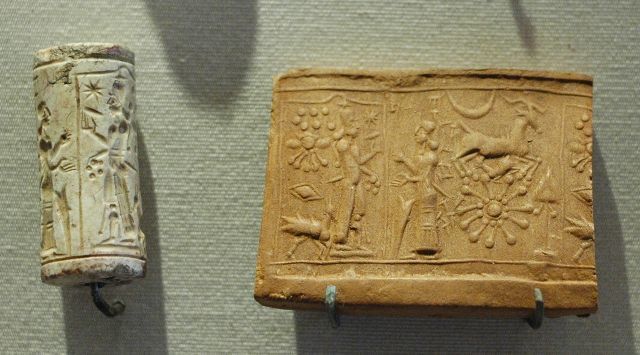
Mesopotamian Cylinder Seal

Scenes also depicted magical or religious events reserved for small groups of people, such as ministers or officials.

Materials used for the cylinders were clay and various precious and semiprecious stones, including lapis lazuli.

Lapis lazuli was a highly valued stone in ancient Mesopotamia, credited with symbolic and magic qualities.

Cylinder seals are very important in the history of mankind because they opened the way for the birth of cuneiform writing, which appeared for the first time in Mesopotamia.

Cuneiform writing improved on forms of writing based on figurative depiction of reality, meaning that symbols became the basis of written communication.

Dan Brown has a real passion for symbols. Robert Langdon, the main character in Inferno as well as in three of his other novels, is a famous American symbologist and art historian.

Dan Brown probably mentioned the cylinder seal in Inferno as a direct reference to the origins of cuneiform writing.

In the novel, a cylinder seal bore a particularly gruesome image of a three-headed Satan along with a single word: saligia.

Picture by Wikimedia

About the author
Florence Inferno

Florence Inferno

Florence Inferno is a blog about the Florentine mysteries, symbols, and places that are mentioned in Dan Brown’s latest novel Inferno, and much more about the city. We also offer a guided Inferno walking tour, which follows the footsteps of Robert and Sienna, as well as an an eBook with an audio version.

Related posts
Palazzo Vecchio Salone dei Cinquecento by Bruna Benvegnu
The Battle of Marciano
July 16, 2017
Coat of arms of an Italian family with Ghibelline-style heraldic chief at top
Guelphs and Ghibellines
April 19, 2017
Panels of Gates of Paradise by Justin Norris
Gates of Paradise
January 15, 2017
The Dance of the Black Death in a medieval allegory
The Black Death
August 8, 2016
Biohazard Level 4 by Simon Strandgaard
The Biohazard Symbol: Meaning, History & Inspiration
July 13, 2016
Staff of Asclepius by Tmelu
The Rod of Asclepius and Caduceus: Two Ancient Symbols
June 27, 2016
The Florence Inferno eBook
A Guide to Florence per Dan's Brown Inferno Discover Dan Brown's Florence on your own with our audio guide and eBook.
Read more »
Stay in Touch
Want to get our posts via email?
By clicking on "Subscribe" you agree to receive our newsletter. Read our privacy policy. If you change your mind you'll find a link to unsubscribe in each email we'll send you.
Blog Categories
  • Dan Brown's Inferno: Book & Movie
  • Dante and His Work
  • Events in Florence
  • Inferno's Personalities
  • Inferno's Places
  • Inferno's Symbols
  • Miscellany
  • Mystery Stuff
  • Works of Art
Blog Topics
Art Artists Baptistry Boboli Gardens Books Bridges Churches Dan Brown Dante Alighieri Districts Divine Comedy Duomo Food Geography History Hotels Inferno's Characters Interviews Istanbul Lifestyle Medici Family Movies Museums Palaces Palazzo Vecchio Parks Santa Maria Novella Sociology Squares Streets Symbology Theology Thinkers Trains Venice
Tickets & Guided Tours
Discover more »
Search
© 2013-2026 Florence Inferno {CC BY-NC-ND 4.0} • Termetour S.r.l. Via Garibaldi 33, 51016 Montecatini Terme (Pistoia, Tuscany, Italy) • CF / P. IVA (VAT) 01426700470
Cap. soc. 12000€ I.V. • PEC termetour@pec.it • REA PT14851 Aut. N° 22806 del 14.03.2001 • Responsabilità civile degli organizzatori di viaggio (insurance)
704235585 01 SAI Fondiaria S.p.a. • Web design by Simone Montanari. Concept, SEO & web / content marketing by Pasta SEO • Email info@florenceinferno.com

Privacy Policy • Cookie Policy
Free blog counters